 En
En  中文简体
中文简体 西班牙语
西班牙语

Article Directory
- 1 PET Release Film Properties
- 2 Silicone-Coated PET Release Film
- 3 PET Release Film Applications
- 4 PET Release Liner for Adhesive Products
- 5 PET Film Release Coating: How It's Applied
- 6 Release Film for Die Cutting
- 7 PET Release Film for Electronics and Flexible Circuits
- 8 PET Release Film Thickness Selection
- 9 Release Film vs Protective Film
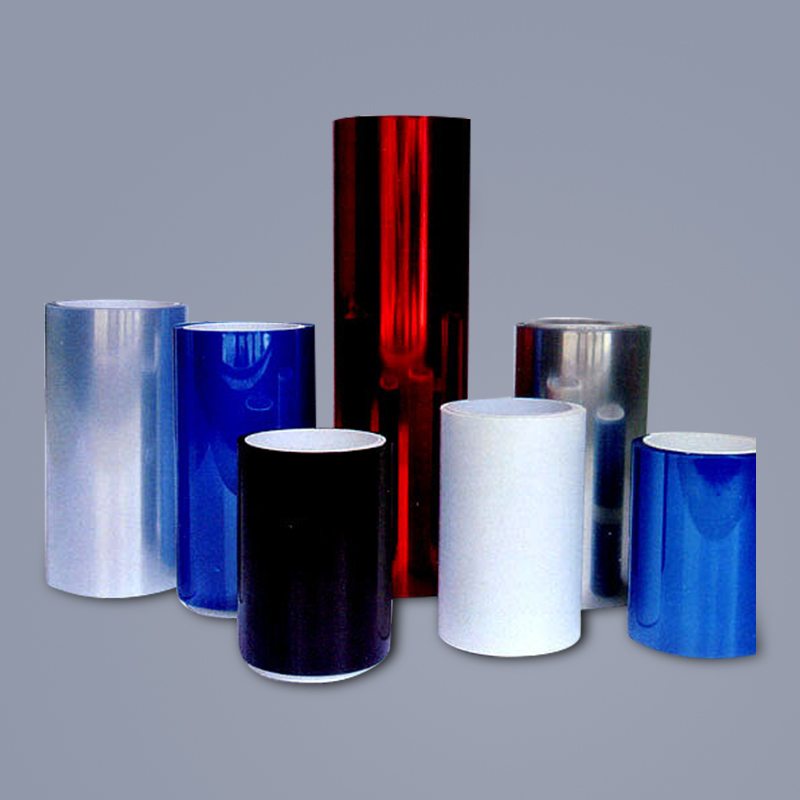
PET release film is a polyester (PET) plastic film coated with a release agent — most commonly silicone — that allows it to bond temporarily and lightly to an adhesive or resin surface, then peel away cleanly without leaving residue or damaging the underlying material. It functions as a temporary, non-stick barrier during manufacturing, protecting an adhesive layer, molded surface, or coated material until the point where that surface needs to be exposed or bonded to something else.
PET is chosen as the base film specifically for its dimensional stability, heat resistance, and mechanical strength, all of which allow the release film to withstand the manufacturing processes — heat curing, pressing, laminating — it's exposed to before being peeled away and discarded or, in some processes, reused.
PET Release Film Properties
| Property | Characteristic |
|---|---|
| Release force | Tunable via silicone coating formulation, from light to heavy release |
| Heat resistance | Withstands typical curing and lamination process temperatures |
| Dimensional stability | Minimal shrinkage or distortion under heat and mechanical stress |
| Surface smoothness | Consistent, controllable surface finish transferred to the contacted material |
| Chemical resistance | Resists most solvents and process chemicals encountered in manufacturing |
Silicone-Coated PET Release Film
Silicone coating is the most common release agent applied to PET film, chosen because silicone provides consistent, controllable release force while remaining chemically stable across a wide range of adhesives, resins, and process temperatures. Coating weight and cure level directly determine release force — a lighter, less cross-linked silicone coating produces easier, lower-force release, while a heavier or more fully cured coating produces firmer adhesion and higher release force, allowing manufacturers to specify exactly the release characteristic a given process requires.
Why this tunability matters
Different applications need very different release forces — a light-release film that peels away with almost no resistance suits delicate adhesive tapes, while a tighter release film that requires deliberate peeling force suits applications where premature separation during handling would be a defect.
PET Release Film Applications
- Protecting pressure-sensitive adhesive (PSA) tapes and labels before application
- Composite material and prepreg manufacturing, protecting resin surfaces during layup and curing
- Printed circuit board and flexible circuit manufacturing processes
- Die-cutting and converting processes, protecting adhesive-coated stock during cutting
- Silicone and rubber molding, providing a clean, non-stick surface during curing
- Graphic arts and screen printing, protecting printed or coated surfaces during production
PET Release Liner for Adhesive Products
In adhesive tape and label manufacturing, PET release liner sits against the pressure-sensitive adhesive layer, protecting it from contamination and premature bonding during storage, shipping, and handling — right up until the end user peels it away to expose the adhesive for application. Consistent, predictable release force is critical in this application, since a liner that releases too easily can separate prematurely during handling or converting, while one that releases too firmly can make the finished product difficult or frustrating for the end user to apply correctly.
PET Film Release Coating: How It's Applied
Release coating is typically applied to PET film using a precision coating process — gravure, roll, or slot-die coating are common methods — that deposits a thin, uniform silicone layer across the film's surface, followed by a curing step (usually thermal) that cross-links the silicone into a stable, durable release surface. Coating uniformity directly affects release force consistency across the film's width and length, which is why manufacturers monitor coating weight closely during production rather than treating it as a set-and-forget parameter.
Release Film for Die Cutting
Die-cutting operations use release film to protect adhesive-coated material during the cutting process, allowing the finished die-cut parts (labels, gaskets, tape pieces) to be handled, stacked, and shipped without the adhesive layer sticking prematurely to other surfaces or itself. Release force needs to be matched carefully to the die-cutting process itself, since the film also needs to hold the material flat and stable during cutting without shifting, while still releasing cleanly afterward without pulling adhesive off the cut parts.
PET Release Film for Electronics and Flexible Circuits
Electronics manufacturing, particularly flexible printed circuit (FPC) production, relies on PET release film during lamination steps where adhesive layers, coverlay films, or resin materials need to be pressed and cured against the circuit substrate without permanently bonding to process tooling or protective layers. Cleanliness and low particulate generation matter significantly in this application, since any contamination transferred from the release film to the circuit surface during lamination can create defects in the finished flexible circuit — a concern that pushes electronics-grade release film toward tighter manufacturing controls than general-purpose release film applications require.
PET Release Film Thickness Selection
Film thickness affects both mechanical handling properties and process performance, with thinner films (typically 25-50 microns) offering better conformability for processes involving curved or irregular surfaces, while thicker films (75-125 microns and above) provide greater dimensional stability and tear resistance for processes involving higher mechanical stress or repeated handling.
- Thin films (25-50 microns): flexible circuit lamination, applications needing conformability around curves or contours
- Mid-range films (50-75 microns): general adhesive and label liner applications
- Thicker films (75-125+ microns): composite/prepreg processing, applications with repeated handling or higher mechanical stress
Release Film vs Protective Film
| Factor | Release Film | Protective Film |
|---|---|---|
| Primary function | Non-stick barrier for a process step (curing, laminating, molding) | Surface protection against scratches, dust, and handling damage |
| Coating | Silicone or other release agent coating | Often has a light adhesive to stay in place during handling/shipping |
| Typical use point | During manufacturing, removed before the product is finished | Applied to a finished product, often removed by the end user |
| Heat/process resistance | Generally engineered for process heat and chemical exposure | Generally not exposed to significant process heat |