 En
En  中文简体
中文简体 西班牙语
西班牙语

Article Directory
What Is APET — And How It Differs From Standard PET
APET stands for Amorphous Polyethylene Terephthalate. It is a specific physical form of PET resin in which the polymer chains are arranged in a predominantly disordered, non-crystalline (amorphous) state — rather than the tightly packed crystalline structures found in other PET forms. This distinction in molecular arrangement is what gives APET its defining processing and optical characteristics, and it is why APET and standard semi-crystalline PET serve different end markets despite sharing the same base chemistry.
PET (Polyethylene Terephthalate) as a material family encompasses several structural forms depending on how the polymer is processed after polymerization. When PET melt is cooled rapidly — quenched — the chains do not have time to align into crystalline structures and are frozen in a disordered state. This is APET. When PET is cooled slowly or subjected to solid-state crystallization, a semi-crystalline structure forms, producing CPET (Crystalline PET) or standard bottle-grade PET. A third variant, GPET (Glycol-modified PET, also called PETG), introduces a co-monomer to permanently suppress crystallization even under slow cooling.
Key Properties of APET
- Exceptional optical clarity — the amorphous structure scatters very little light, giving APET sheet a glass-like transparency with haze values typically below 2% at standard gauges. This is the primary reason it dominates food packaging thermoforming where product visibility drives purchase decisions.
- Good thermoformability — APET softens predictably across a processing window of approximately 80–130°C, enabling deep-draw thermoforming into trays, clamshells, and blisters with consistent wall thickness distribution.
- Rigidity at ambient temperatures — despite being amorphous, APET has a glass transition temperature (Tg) of approximately 75–80°C, meaning it remains stiff and dimensionally stable at room temperature and under refrigeration.
- Food contact approval — APET complies with FDA 21 CFR and EU Regulation 10/2011 for direct food contact across a wide range of food types and temperatures.
- Recyclability — APET is compatible with the established PET (#1 resin) recycling stream, an increasingly important criterion for retail packaging specifications in Europe and North America.
The principal limitation of APET is its limited heat resistance. Because it is amorphous, APET begins to soften near its Tg — making it unsuitable for oven-ready meal trays or hot-fill applications. For those uses, CPET (which can withstand temperatures up to 220°C) is the appropriate alternative.
APET vs PET: A Practical Comparison Across Applications
The comparison between APET and other PET forms is most meaningful in the context of specific applications. The table below summarizes the key differentiators between APET, CPET, and bottle-grade semi-crystalline PET that buyers and product designers most frequently need to evaluate.
| Property | APET | CPET | Bottle-grade PET |
|---|---|---|---|
| Crystallinity | Amorphous (<5%) | Semi-crystalline (30–45%) | Low to moderate (orientation-induced) |
| Optical clarity | Excellent (glass-like) | Opaque / milky white | Excellent (biaxially oriented) |
| Max service temp. | ~70°C | ~220°C (ovenable) | 60–70°C (unfilled) |
| Thermoformability | Excellent | Good (requires higher temp) | Not applicable (blow-molded) |
| Typical form | Sheet / film | Sheet / tray | Pellet / preform / bottle |
| Primary application | Cold food packaging, blisters, clamshells | Oven-ready meal trays | Beverage bottles, jars |
| Recyclability | Yes — #1 PET stream | Yes — #1 PET stream | Yes — #1 PET stream |
In rigid packaging procurement, APET sheet is the default choice for chilled and ambient food trays, bakery clamshells, produce containers, and pharmaceutical blister backing where clarity and thermoformability outweigh heat resistance requirements. CPET is specified exclusively when the same tray must go from freezer to conventional oven — a narrower but high-value segment in ready meal retail. Where buyers encounter "PET sheet" in supplier listings without further qualification, it is most commonly APET in practice, though this should always be confirmed with a data sheet.
Metalized Polyester Film: Structure, Manufacturing, and Applications
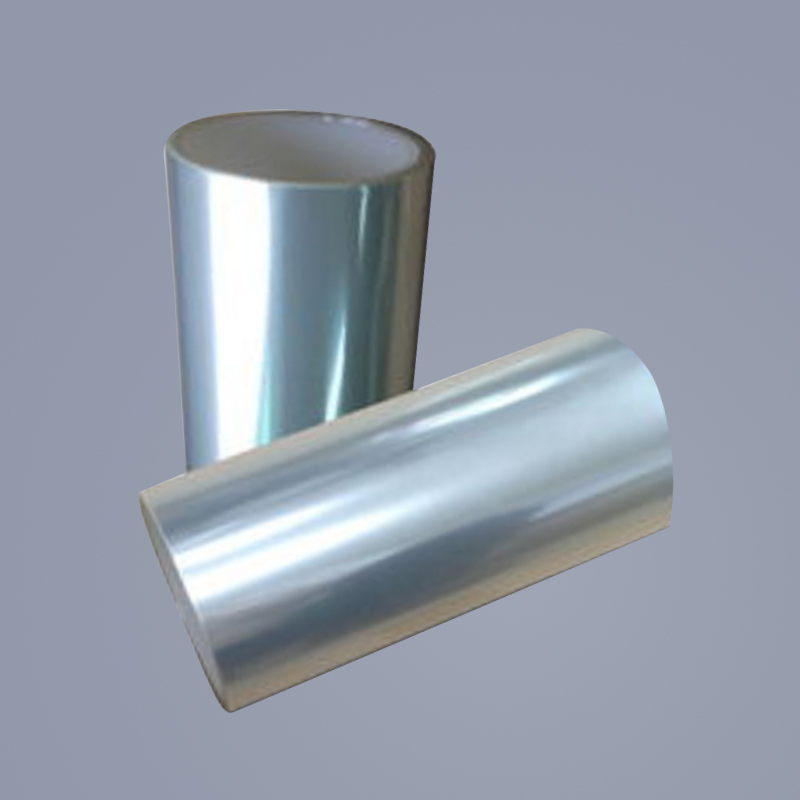
Metalized polyester film — most commonly produced on biaxially oriented PET (BOPET) film substrates — is manufactured by depositing an extremely thin layer of aluminum metal onto the film surface under high vacuum conditions. The process is called vacuum metallization or physical vapor deposition (PVD). The aluminum layer is typically 20–100 nanometers thick — roughly 500 times thinner than a human hair — yet this deposit is sufficient to transform a transparent film into a highly reflective, barrier-enhanced material.
The Vacuum Metallization Process
BOPET film is unwound and passed through a vacuum chamber maintained at pressures of 10⁻⁴ to 10⁻⁵ mbar. Aluminum wire or pellets are fed onto electrically heated ceramic boats or an electron beam gun, where they vaporize. The aluminum vapor condenses onto the moving film surface in a continuous, uniform layer. Deposition speed, chamber vacuum, and aluminum evaporation rate are all controlled to achieve the target optical density (OD) — typically OD 2.0–3.5 for standard packaging metallization, where higher OD values correspond to greater reflectivity and barrier performance.
After metallization, the film is typically corona-treated and wound. A thin protective lacquer or primer coat is often applied over the metal layer to prevent oxidation and improve ink adhesion for subsequent printing processes.
Properties and Performance
- Barrier performance — metalized BOPET achieves oxygen transmission rates (OTR) of 1–5 cm³/m²/day and water vapor transmission rates (WVTR) of 0.2–1.0 g/m²/day at standard conditions. These values are significantly better than uncoated PET film, though inferior to foil laminates. For dry snack foods, coffee, and confectionery, this barrier level is typically sufficient.
- Reflectivity — standard aluminum-metalized PET reflects 85–95% of incident light, enabling the high-gloss metallic aesthetics used in premium flexible packaging, gift wrapping, and decorative laminates.
- Weight and cost advantage over foil — at 12–23 µm total thickness, metalized BOPET is substantially lighter than aluminum foil laminates and costs significantly less per square meter, while providing comparable aesthetics and adequate barrier for many applications.
- Thermal insulation — metalized polyester film reflects radiant heat, making it a core material in emergency blankets, building insulation facings, and thermal packaging for pharmaceuticals and perishables.
Common Applications
- Flexible food packaging — snack bags, coffee pouches, confectionery wrappers, and lidding films where both barrier and shelf-appeal are required.
- Holographic and decorative films — metalized BOPET is the substrate for embossed holographic films used in security labels, gift packaging, and anti-counterfeiting applications.
- Capacitor dielectric films — ultra-thin metalized BOPET (3–6 µm) with precisely controlled aluminum deposit thickness serves as the active dielectric in film capacitors for power electronics.
- Thermal and insulation products — multi-layer insulation (MLI) in aerospace, radiant barriers in building construction, and cold-chain packaging liners all rely on metalized polyester film's radiant heat reflectance.
- Hot stamping foil carrier — metalized PET film serves as the carrier web for hot stamping foil transfer, releasing the decorative metal layer onto paper, board, or plastic under heat and pressure.
PET Release Film: Function, Construction, and Industrial Uses
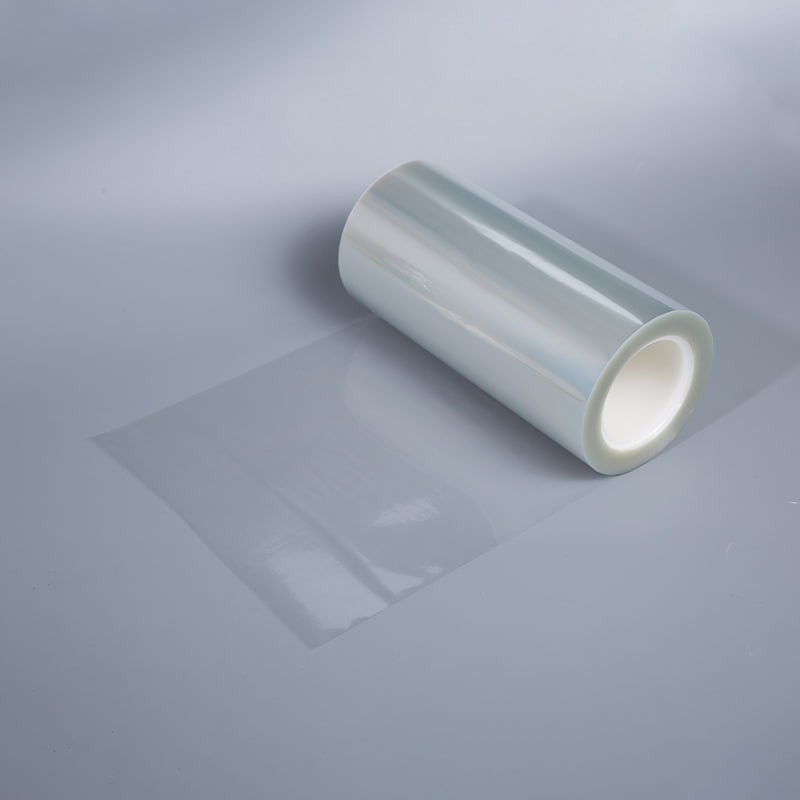
PET release film is a polyester film — most commonly BOPET — that has been coated on one or both surfaces with a release agent, typically a silicone-based compound, to create a low-energy surface from which adhesives, resins, and coatings can be cleanly peeled away without leaving residue. The release film protects an adhesive or substrate layer during storage, handling, and converting, then is removed immediately before final application.
Construction and Release Force Classification
PET release films are specified primarily by their release force — the peel strength required to separate the film from the adhesive or resin it protects. Release force is measured in cN/25mm (centinewtons per 25mm width) and classified into functional categories:
- Ultra-light / easy release (2–5 cN/25mm) — used where the release film must be peeled away with minimal force, such as protective liners for pressure-sensitive labels, graphic films, and thin adhesive membranes.
- Light to medium release (5–30 cN/25mm) — the most common range for industrial tape liners, adhesive transfer films, and composite prepreg carriers.
- Tight release (30–150 cN/25mm) — used where the release film must remain securely bonded during aggressive processing — hot lamination, die cutting, or high-pressure pressing — and only releases under deliberate force at the end of the process.
The silicone release coating is applied by gravure, reverse gravure, or slot-die coating methods, cured by thermal or UV energy, and must achieve uniform thickness across the full web width — coating weight variation above ±5% produces measurable inconsistency in release force that causes delamination or adhesive transfer failures in downstream converting operations.
Why PET Is Preferred Over Paper or PE Release Substrates
While silicone-coated paper liners and polyethylene-coated release films are used in high-volume label and tape applications, PET release films offer specific performance advantages that justify their higher cost in demanding applications:
- Dimensional stability — BOPET is biaxially oriented and exhibits very low thermal expansion, moisture absorption, and elongation under tension. This is critical in precision coating and laminating lines where register accuracy must be maintained across wide webs at high speeds.
- Surface smoothness — calendered BOPET achieves Ra (roughness average) values of 20–100 nm, transferring this smoothness to cast adhesive or resin layers and producing a glossy, defect-free adhesive surface.
- Heat resistance — PET release films withstand processing temperatures up to 150–180°C, enabling their use as process carriers in composite lay-up, prepreg manufacturing, and hot-melt adhesive coating operations where paper liners would degrade.
- Chemical inertness — PET does not react with solvent-based coating systems and does not contribute extractables that could contaminate UV-curable, epoxy, or acrylic adhesive formulations.
Key Application Segments
- Pressure-sensitive adhesive (PSA) tape and label manufacturing — PET release film is used as the casting substrate onto which PSA is coated and dried, then transferred to the face material. The release film is wound out and either recycled or reused.
- Composite and prepreg manufacturing — carbon fiber, glass fiber, and aramid prepreg sheets are interleaved with PET release film during layup to prevent unwanted bonding between plies before autoclave cure.
- Electronics and optical film lamination — protective liners on optical adhesive films (OCA), polarizer sheets, and touch panel adhesives are PET release films, protecting surfaces from contamination and scratching through the supply chain until final assembly.
- Medical and hygiene products — wound dressings, transdermal drug delivery patches, and surgical drapes use PET release liners to protect the adhesive layer until point of application, where easy, consistent peel-off is a patient safety requirement.
- Graphic arts and digital printing — self-adhesive vinyl films and digital print media use PET release liners to enable die-cut shapes to be peeled and applied cleanly to substrates during signage and vehicle wrap installation.
When specifying PET release film for a new application, buyers should define base film thickness (commonly 25, 36, 50, 75, or 100 µm), required release force range, single-sided or double-sided release, surface roughness if the adhesive finish quality is critical, and whether antistatic treatment is needed for electronics applications. Mismatch between release force specification and adhesive tack level is the leading cause of liner delamination failures in automated label dispensing and tape converting operations.