 En
 中文简体


Article Directory
- 1 What Release Force Actually Means in Die-Cutting
- 2 Light, Medium, and Heavy Release PET Films at a Glance
- 3 Light Release PET Films: Where Low Force Wins
- 4 Medium Release PET Films: The Converting Workhorse
- 5 Heavy Release PET Films: When the Adhesive Demands It
- 6 Matching Release Force to Your Die-Cutting Process
- 7 Variables That Shift Release Force After You Choose
- 8 Common Die-Cutting Problems and Their Release Force Causes
- 9 How a Release Film Supplier Helps You Lock the Right Grade
- 10 Frequently Asked Questions
Die-cutting is a tolerance game. Laminate, cut, strip, rewind — every step inherits the error of the one before it, and the film sitting under the adhesive sets the baseline. Light, medium, and heavy release PET films are separated by only a few grams per inch of peel force, yet that narrow band decides whether a rotary press holds register at 80 m/min or throws waste matrix across the floor.
Choosing a release film means choosing how easily the adhesive lets go of its carrier. Too light, and the material releases before the job is done. Too heavy, and the cut parts will not come away. The target is the point where release is clean, predictable, and consistent from the first metre of a roll to the last. This guide sets out how to find that point.
What Release Force Actually Means in Die-Cutting
Release force, also called peel force, is the pull required to separate an adhesive from a release film surface at a defined angle and speed. Converters usually quote it in grams per inch (g/in) or the metric equivalent, cN/25 mm.
The important point is that release force is not a fixed property of the film. It describes a relationship between the film and the adhesive touching it, and the number moves with test conditions:
- Peel angle — a 180-degree peel and a 90-degree peel give different readings on the same sample.
- Peel speed — a laboratory bench pulls slowly; a rotary die-cutter does not.
- Dwell time — the longer the adhesive sits on the liner, the higher the force climbs.
- Temperature and humidity — a warm, humid converting hall behaves differently from a climate-controlled one.
- Adhesive chemistry — rubber, acrylic, and hot-melt systems each interact differently with the same silicone coating.
Two suppliers can both label a product "medium release" and still deliver materials that differ by a factor of three, because they tested under different conditions. Ask what the number describes, then confirm it with your own peel test at production speed.
Light, Medium, and Heavy Release PET Films at a Glance
The three grades are normally defined by peel force ranges. The figures below are typical working ranges, not absolutes.
| Release Grade | Typical Peel Range | Adhesive Profile | Die-Cutting Behaviour |
|---|---|---|---|
| Light | Roughly 3–12 g/in | Low-tack, soft, or microsphere adhesives | Releases with minimal tension; suits thin facestocks and high line speeds |
| Medium | 12–40 g/in | Standard rubber and acrylic systems | Widest converting window; works across most rotary and flatbed setups |
| Heavy | 40–150 g/in | High-tack, heavy-coat, or aggressive adhesives | Prevents pre-release; raises stripping tension and loads fine cutting edges |
Treat those boundaries as a starting hypothesis. A heavily coated light-release liner can behave like a medium-release product, and silicone coating weight varies across a single roll by more than most buyers expect.
Light Release PET Films: Where Low Force Wins
Light release film excels wherever the material cannot tolerate being dragged. When peel force runs high, the tension needed to remove the liner travels through the whole web, and thin facestocks, soft films, and small die-cut parts deform or tear long before they reach the waste take-up.
The familiar applications for light release PET film include:
- Membrane switches and graphic panels, where registration has to survive the peel
- Small labels laid out in dense, closely spaced patterns
- High-speed die-cutting, where peel tension adds to web and rewind tension
- Low-tack adhesive systems that let go without persuasion
- Thin aluminium foil and paper facestocks
The risk is premature separation. If the adhesive is genuinely aggressive, a light liner may release during slitting or transport, and the symptom usually appears as curled label edges after rewind.
Medium Release PET Films: The Converting Workhorse
When in doubt, medium release is the safe default. It gives the process a forgiving window: light enough that stripping stays clean, heavy enough that the adhesive stays flat through handling.
Medium release PET film carries the bulk of general-purpose die-cutting work — standard labels and stickers, double-sided tapes built on acrylic systems, film facestocks, and medium-speed coating and slitting. It also tolerates the small shifts in coating weight and ambient conditions that a light liner would punish immediately.
If you want a broader picture of how the release grades sit relative to one another and how each behaves through converting, this technical guide to light-to-heavy release PET films is a useful companion read.
Heavy Release PET Films: When the Adhesive Demands It
Heavy release PET film exists for adhesives that grip hard. Thick hot-melt coatings, high-tack acrylics, heavy double-sided foam tapes, and some medical plasters will seize the first surface they touch and creep away from a light liner during storage. A heavier coating holds them in place.
The cost shows up at stripping. Heavy liners raise the tension at the waste station, and that tension is transmitted to every cut part. For plain labels this is rarely a problem. For narrow necks, fine lines, and thin small parts, it is, because the die has to break the material cleanly rather than drag it. Before specifying heavy release, confirm that your tooling has the edge sharpness and pressure to carry the extra load.
Matching Release Force to Your Die-Cutting Process
The release grade is one input; the process is the filter. Work through this sequence and most errors are caught before the roll reaches the press.
- Test the adhesive before you test the liner. Measure actual peel behaviour on a real sample at production speed and angle. A supplier datasheet is a starting point, not a verdict.
- Calculate stripping tension. The tighter the waste take-up, the narrower the usable release range. Thin, easily stretched facestocks tolerate very little.
- Check dwell behaviour. Take samples from the tail of a roll as well as the head, then compare. If force climbs within days, specify against the aged value rather than the fresh one.
- Look at the facestock. Membrane switches, thin foils, and soft labels all object to high peel force.
- Allow for ageing. A light liner that turns into a medium one after six weeks was arguably a medium liner all along.
- Run a trial. Cut 500 metres with the production die and watch how the waste behaves, not just how the force reads.
Practical rule of thumb: choose the lightest release film that still keeps the adhesive flat through stripping and rewind. Every step heavier adds tension to a process that does not need more of it.
Variables That Shift Release Force After You Choose
Peel force is not locked in when the order is placed. It keeps moving between the warehouse and the press.
- Silicone coating weight sets the baseline. Small variations in application shift the reading across a roll.
- Film gauge and stiffness change how the liner bends during peel, which nudges the measured value.
- Ageing typically raises force over the first days or weeks before it plateaus.
- Temperature and humidity affect both the coating and the adhesive, so a liner that behaves in a hot converting hall may read differently in controlled storage.
- Contact pressure and rewind tension influence how deeply the adhesive keys into the silicone, especially with soft adhesives.
- Die wear does not change release force, but it narrows the range the process can tolerate.
Common Die-Cutting Problems and Their Release Force Causes
Most die-cutting faults trace back to a release decision. The table below maps typical symptoms to the adjustment that usually resolves them.
| Symptom | Likely Release Force Cause | Adjustment |
|---|---|---|
| Small parts fly off during stripping | Release force too light | Move to a medium or heavy grade |
| Adhesive lifts with the waste matrix | Release force too heavy | Step down to a medium or light grade |
| Label edges curl after rewind | Pre-release from a light liner | Increase release force or shorten rewind dwell |
| Narrow necks and fine lines tear | Web tension too high | Reduce release force; re-check die sharpness |
| Release drifts from roll to roll | Inconsistent coating weight or ageing | Tighten incoming specs and storage conditions |
How a Release Film Supplier Helps You Lock the Right Grade
Anhui Hengbo New Material Co., Ltd. manufactures PET polyester film, PET release film, and protective film from its base in Anhui Province, China. The company holds ISO9001 certification, has completed safety production standardisation acceptance, and describes two decades of manufacturing experience. Its release materials serve printing, screen printing, membrane switches, flexible circuits, insulating products, adhesive goods, medical plasters, and die-cutting operations — the same sectors where release force decisions carry the most weight.
What to Send When Requesting Samples
To receive a useful recommendation rather than a generic datasheet, supply your adhesive type and coating weight, your test method and peel speed, the facestock and total laminate thickness, and the smallest die-cut feature on the job. Hengbo's stated approach is to discuss a customer's new product directly and give technical suggestions before a material is specified, so these details are worth preparing in advance.
It also helps to review release force alongside thickness, roll width, and splicing requirements, since those sourcing specifications for PET release film determine whether the behaviour you measured in a sample survives a full production run.
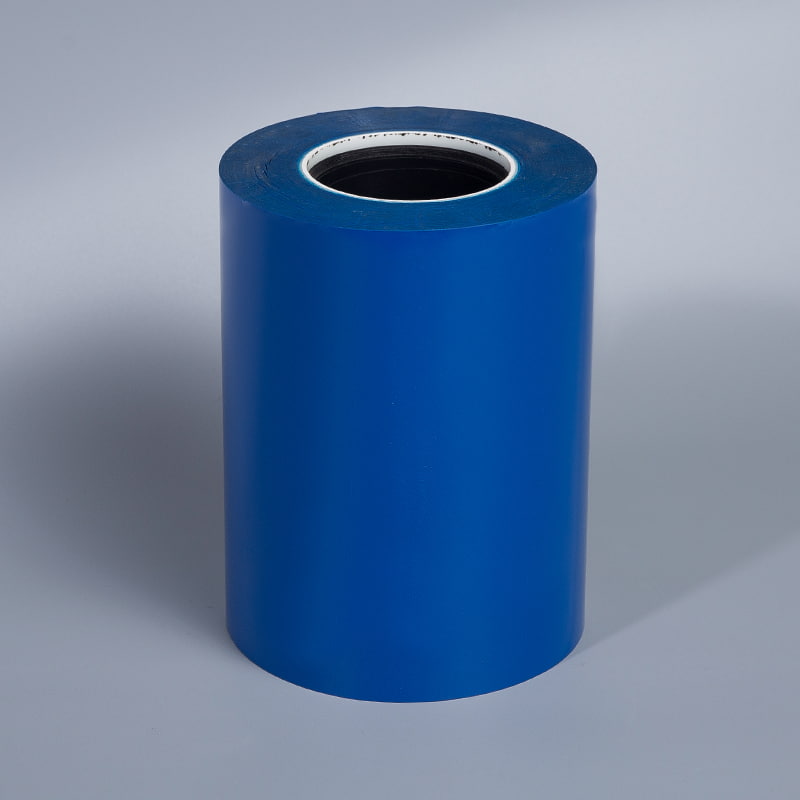 PET Silicone Release Film for Adhesive ConvertingSilicone-coated PET release liner in multiple colors, surfaces, thicknesses, and release options; review release force and roll specifications when selecting for converting.View Product →
Frequently Asked Questions
Q1: Should I start with light, medium, or heavy release film?
Start with medium unless you have a specific reason not to. It is the grade with enough headroom to absorb normal variation in adhesive coating weight, ambient conditions, and roll ageing. Move lighter only when the facestock is too delicate for the resulting tension, and heavier only when the adhesive demonstrably pre-releases.
Q2: Does a thicker PET release film always mean a higher release force?
No. Release force comes mainly from the silicone coating, not the film gauge. Thickness changes stiffness and how the web behaves under tension, which can influence the measured peel slightly, but a 50-micron and a 100-micron film with the same coating will read close to each other.
Q3: Why does release force drift across a single roll?
Coating weight variation during silicone application is the usual cause, sometimes compounded by uneven ageing when the outer layers of a roll see warmer air than the core. If the drift is large enough to change stripping behaviour, the incoming specification needs tightening rather than the process adjusting.
Q4: Can one release film work with several different adhesives?
Sometimes, but only within a narrow band. A medium-release film may suit a standard acrylic and a moderate rubber adhesive, yet fail on a heavy hot-melt. Once your adhesive portfolio widens, running two grades is usually cheaper than absorbing the rejects from forcing one.
Release force selection rewards a little measurement up front and costs very little to correct. Define the test conditions, match the grade to the adhesive rather than to the label on the box, and confirm the choice on a short production run. The right film is rarely the most aggressive one — it is the lightest grade that still keeps the adhesive exactly where it belongs until you decide otherwise.