 En
En  中文简体
中文简体 西班牙语
西班牙语

Article Directory
- 1 Base Paper Structure: Where Copperplate Paper Release Paper Performance Is Set
- 2 Silicone Coat Weight and Cross-Linking Control Copperplate Paper Release Paper Release Force
- 3 Clay-Coated Surface Smoothness and Printability
- 4 Release Force Consistency and Aging Resistance
- 5 Moisture, Curl and Storage Stability
- 6 Supplier Quality Systems and Incoming Inspection
- 7 Frequently Asked Questions
- 7.1 What is the standard test for release force on copperplate paper release paper?
- 7.2 What silicone coat weight is typical for copperplate paper release paper?
- 7.3 What causes copperplate paper release paper to curl during converting?
- 7.4 How many splices are acceptable in a roll of copperplate paper release paper?
Converters, die-cutters and medical adhesive producers should evaluate copperplate paper release paper the same way they evaluate adhesives: by specification, by repeatable test method, and by batch history. The factors below are the levers that matter.
Base Paper Structure: Where Copperplate Paper Release Paper Performance Is Set
The base copperplate sheet, not the silicone layer, sets the mechanical limit of a release liner; grammage, caliper and internal bond control everything downstream.
Copperplate paper release paper starts as a kraft base, normally 120 to 180 g/m2, clay-coated on one side. When base formation is uneven, clay settles into valleys and silicone wet-out becomes irregular, which shows up later as mottled peel.
Caliper uniformity is the most critical base parameter; a capable supplier holds thickness within +/-4 um across the web. Wider swings change wound-roll compression, create baggy edges and shift die-cut depth enough to cause skip-cut or through-cut defects. Internal bond above 200 J/m2 (Scott Bond) prevents clay delamination and white dust on the adhesive.
| Parameter | Typical range | What it controls |
| Grammage | 120 to 180 g/m2 | Liner stiffness and die-cut depth feel |
| Caliper profile | Within +/-4 um across web | Nip pressure and knife depth under the die tool |
| Moisture content | 6 to 8 percent | Flatness and curl after unwinding |
| Scott Bond | Above 200 J/m2 | Clay-layer anchorage and dust generation |
| Bendtsen smoothness | Equal to or below 25 mL/min | Silicone coverage demand and print quality |
Silicone Coat Weight and Cross-Linking Control Copperplate Paper Release Paper Release Force
Release force is generated by the silicone layer, and two variables define it: the applied dry coat weight and the degree of cross-linking of the silicone network.
On clay-coated copperplate, dry silicone coat weight normally runs 0.6 to 1.5 g/m2. At the lower end, micropores stay uncovered and adhesive anchors to paper, causing lock-up or residue. At the upper end, excess silicone creates haze, slow cure and rising release during storage. Ask for coat-weight data from the head, middle and tail of each roll.
Our guide to copperplate paper release paper coating properties covers this in more detail.
Cross-linking is the second lever. Addition-cure platinum systems must form a complete network without becoming brittle; under-cured silicone releases extractable oligomers that contaminate adhesive, and over-cured silicone raises release force.
Light-release applications
- Medical plasters and transdermal patches
- Low-tack protective labels for glass and plastic
- Single-side foam tapes in electronics
- Target release force: 3 to 12 g/in
Heavy-release applications
- Double-sided tapes and mounting foams
- Insulation and construction membranes
- Graphics films that must hold shape
- Target release force: 20 to 40 g/in
Clay-Coated Surface Smoothness and Printability
Copperplate release paper must be smooth enough for even silicone wet-out and printable enough for marking; both depend on the clay formulation and the base sheet.
Surface smoothness is expressed as Bendtsen airflow or Bekk seconds; a Bendtsen value of 25 mL/min or lower is typical for coated release liner. Rougher surfaces demand extra silicone and produce mottled peel, fiber raps and skipped print dots.
The surface must also accept flexographic and heat-transfer inks after silicone coating; irregular clay shows up as missed characters or dot gain on printed labels and medical patches.
For this reason Anhui Hengbo New Material Co., Ltd. operates a separate copperplate paper release paper line instead of treating it as a variant of PET release film; coating heads, drying profiles and inspection regimes are simply different.
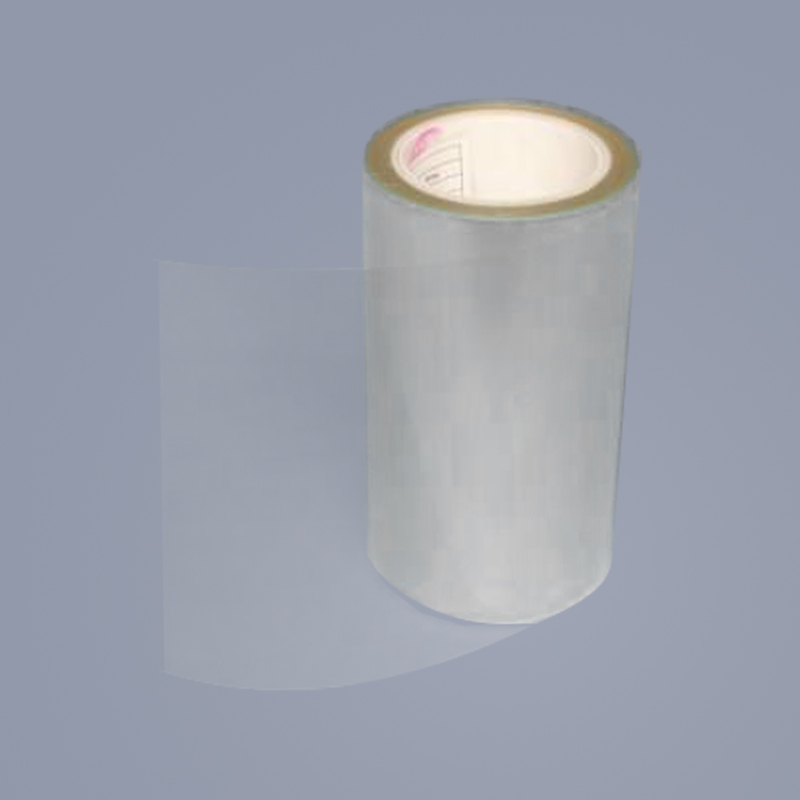 Copperplate Paper Release Paper with Double-Sided CoatingThis coated release paper provides a stable, smooth surface for printing and die-cutting. Its double-sided coating option and dimensional stability make it suitable for nameplates, membrane switches, and insulating products.View Product →
Release Force Consistency and Aging Resistance
The most reliable indicator of copperplate paper release paper quality is not the average release force but the drift between the immediate and aged values measured on the same roll.
Immediate release force is measured after the test tape sits on silicone for 20 minutes; the aged value is measured after the same assembly is conditioned for 24 hours at 40 deg C. A drift beyond +/-15 percent exposes incomplete curing or contamination.
Consistency within one roll matters as much as the absolute number. Values from the core, middle and outer wraps of a 1000 m roll should stay inside a +/-15 percent window; wider swings force constant tension changes and label lifting at the applicator.
Release-force windows by application (180-degree peel, 0.3 m/min, g/in)
Typical operating windows reported by release liner producers; confirm windows with your supplier CoA.| Quality test | Typical method | Common acceptance limit |
| Immediate release force | 180-degree peel at 0.3 m/min with acrylic PSA tape | 3 to 40 g/in depending on grade |
| Aged release force | 24 h dwell at 40 deg C under defined pressure | Drift within +/-15 percent of immediate |
| Silicone coat weight | X-ray fluorescence or solvent extraction | 0.6 to 1.5 g/m2 with even profile |
| Flatness / curl | Condition flat sheet, measure corner lift | Edge lift below 10 mm |
| Splice count | Sensor and visual inspection per roll | Max 2 per 1000 m, marked and below 12 mm |
Moisture, Curl and Storage Stability
Because copperplate paper is cellulosic and hygroscopic, humidity and temperature control flatness and curl faster than any other variable after the roll leaves the factory.
The standard conditioning environment is 23 +/- 2 deg C and 50 +/- 5 percent RH. The clay-silicone side and the plain back side have different permeability; when one side gains or loses moisture faster, differential expansion curls the web. Edge wave, cupping and reverse curl appear in the first meters of unwinding.
Storage discipline is part of quality. Rolls keep their protective wrapping, stay horizontal and stay away from heat; direct sun on outer wraps for hours causes measurable release-force drift as heat pushes silicone toward further cross-linking.
The humidity and temperature impact on release paper rolls guide explains storage room design.
When absolute dimensional stability is required, PET release film does not swell or curl with humidity:
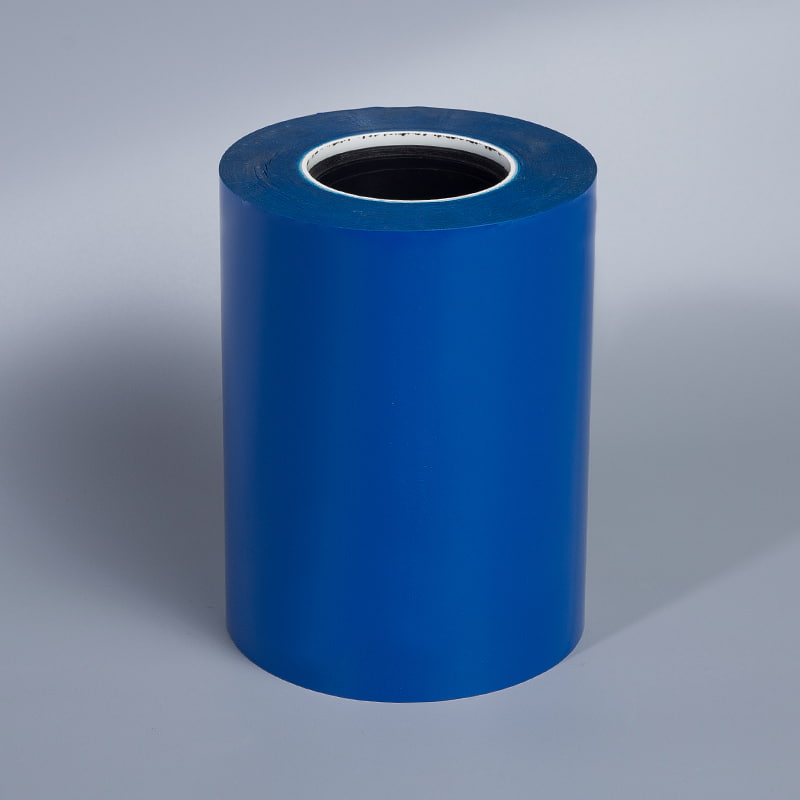 Silicone-Coated PET Release Film for Die-Cutting ApplicationsThis release film offers uniform silicone coating, high transparency, and good dimensional stability. Available in multiple colors and finishes, it suits adhesive bonding, isolation, and die-cutting processes.View Product →
Supplier Quality Systems and Incoming Inspection
Batch consistency is a function of process discipline, and a certificate of analysis without measured values is a warning, not a guarantee.
A usable CoA lists nominal values and measured ranges for grammage, caliper, moisture, silicone coat weight, immediate and aged release force, splice count and splice position. Ask how measurements were made; a roll average is not a head-to-tail profile.
- Request a measured CoA. Reject any lot without silicone coat weight data or release-force windows.
- Sample three positions. Compare release force at outer, middle and core wraps plus three positions across the web.
- Run a pilot. Die-cut or label matrix-stripping test on 100 m before the roll enters production.
- Track the trend. Compare each lot with the previous five deliveries to catch process drift early.
Frequently Asked Questions
What is the standard test for release force on copperplate paper release paper?
A standardized 25 mm wide acrylic PSA tape is applied to the silicone surface with a defined roller, conditioned at 23 deg C and 50 percent RH, and peeled at 180 degrees at 0.3 m/min. Results are reported in g/in or N/25 mm, and the test should be repeated at several positions across the web.
What silicone coat weight is typical for copperplate paper release paper?
Dry silicone coat weight is normally 0.6 to 1.5 g/m2. Light-release medical liners sit near the lower end and heavy tape applications near the upper end. Coat weight is verified with X-ray fluorescence, ICP or solvent extraction.
What causes copperplate paper release paper to curl during converting?
A moisture gradient between the clay-silicone side and the plain back side expands the paper unevenly. Low room humidity, uncovered roll ends and storage on a cold floor accelerate the effect. Keeping 50 +/- 5 percent RH and 23 +/- 2 deg C prevents most curl.
How many splices are acceptable in a roll of copperplate paper release paper?
For high-speed labeling and die-cutting, zero to two splices per 1000 m is typical. Each splice must be marked, butt-spliced, free of silicone-free gaps and no wider than 12 mm. An unmarked splice is a valid reason for rejection.